Customer experience (CX) is often mistaken for dashboards, tools, or processes. But as Kavin Da Silva powerfully reminds us: CX is about people. It’s about learning, listening, and leading with clarity. These are not just professional lessons—they’re mindset shifts for every CX leader.
Here are 10 lessons that highlight why CX must be human-centered, data-informed, and purpose-driven:
- As a customer experience professional, you need to have a deep understanding of people. You can go through a lot of technical stuff, certifications, and hundreds of books—but at the end of the day, what you learn from people is invaluable.
- One of the greatest challenges in customer experience is data blindness. It’s important to understand how to read available data, know how to leverage it, and be specific with it.
- The AI delusion: professionals want AI in everything but don’t know how it works for them. AI can make a cup of coffee for you, but it cannot grow the coffee bush. You need to know where to grow that bush for AI to make the coffee. We need more clarity on how AI works for us.
- Before replicating solutions from Western countries, ask whether it makes relative sense to have what is there over here. Let’s take time to understand whether it is truly pertinent and relevant to our customers.
- In customer experience, we are obsessed with dashboards but allergic to insights. 64% of African businesses say they use AI, but only 14% can actually quantify how it impacts their business. We are painting houses without knowing where the cracks are.
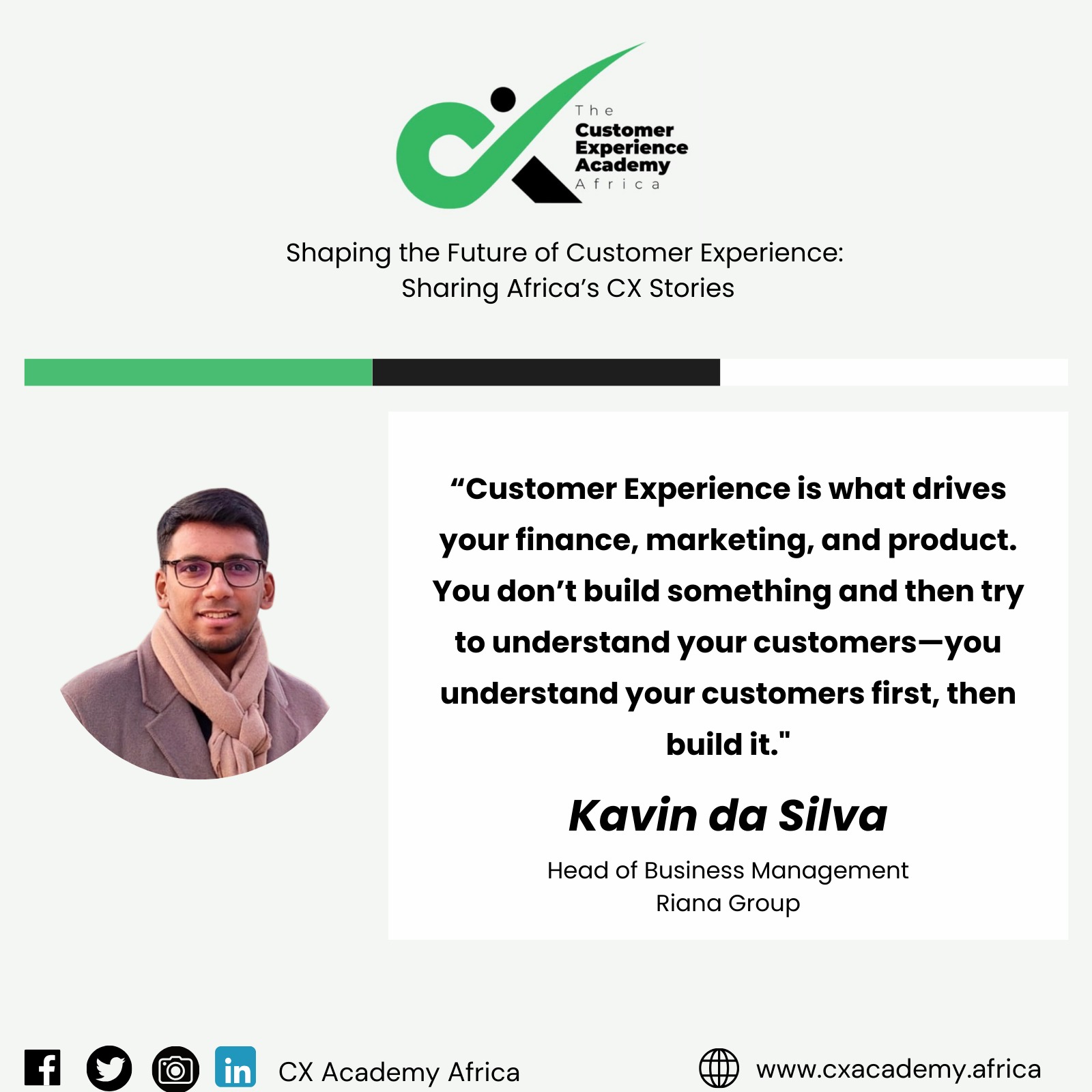
- CX is what drives your finance, marketing, and product. You don’t build something and then try to understand your customers—you understand your customers first, then build.
- CX professionals have to take a hard stand and push further. We have to present CX as an ROI metric to the board. It is the board that needs to understand that CX drives ROI, not the other way around.
- For CX to be heard and felt in the C-suite, we must ask: how can we narrow down CX to bring in the ROI element? How can we translate what we know in CX into an understandable language called ROI for the C-suite? If we can achieve that with cohesion and clarity, CX will stay in the room—not just be called in occasionally.
- For young CX professionals—be curious. Always ask the question “Why?” Then dwell on “How?” You’ll find the answer to whatever problem you are facing.
- Don’t just learn systems, protocols, or strategic initiatives—learn empathy. Learn to listen, to understand, and then respond based on what you have learned and understood.